Quality & Acceptance
10.1 Quality Standards Overview
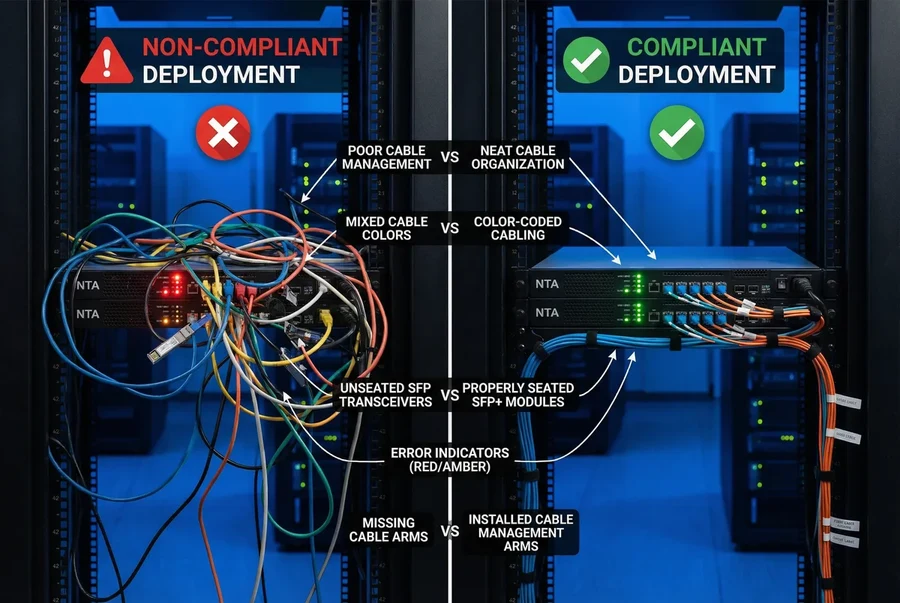
NTA/AD system quality encompasses hardware build quality, software reliability, detection accuracy, and operational performance. A comprehensive quality acceptance program must verify all four dimensions before a system is approved for production operation. The quality comparison below illustrates the visible and measurable differences between a compliant, properly deployed NTA/AD system and a non-compliant deployment that fails to meet minimum quality standards.
10.2 Hardware Quality Acceptance Criteria
Hardware quality acceptance must be performed before software configuration begins. The acceptance process covers physical inspection, power-on self-test (POST) verification, interface connectivity testing, and environmental compliance checks. All acceptance criteria must be documented and signed off by the deployment engineer and the customer's designated technical representative.
| Acceptance Item | Acceptance Criteria | Test Method | Pass/Fail Indicator |
|---|---|---|---|
| Physical Inspection | No physical damage, all panels flush, all screws tightened to spec (0.5 N·m) | Visual inspection + torque check | All panels flush, no visible damage |
| Rack Mounting | Rail kit properly installed, unit slides smoothly, cable management arm functional | Slide test, cable arm flex test | Smooth operation, no binding |
| Power Supply | Both PSUs installed and active, power LED green, no amber fault LEDs | Visual LED check + IPMI power status | Both PSU LEDs solid green |
| SFP/QSFP Transceivers | All transceivers fully seated, DDM readings within spec, no Rx/Tx errors | CLI: show interface transceiver detail | Rx power within −3 dBm of spec |
| Monitoring Port Link | All configured monitoring ports show link-up, correct speed/duplex negotiated | CLI: show interface status | All ports: Link Up, speed correct |
| Management Port | OOB management port reachable, SSH accessible, IPMI/iDRAC responsive | ping + SSH login test | SSH login successful within 5 sec |
| Storage Drives | All drives detected, RAID array healthy, no predictive failure warnings | CLI: show storage status | RAID status: Optimal |
| Cooling | All fans operational, inlet temperature ≤ 25°C, no thermal warnings | IPMI sensor readings | All fans ≥ 80% of rated RPM |
| Cable Management | All cables labeled, color-coded by function, secured with Velcro ties, no sharp bends | Visual inspection against cable plan | 100% cables labeled and secured |
10.3 Software and Detection Quality Acceptance
Software quality acceptance verifies that the NTA/AD platform is correctly configured, that detection capabilities meet the specified performance benchmarks, and that all integrations are functioning correctly. The acceptance test suite must be executed in a controlled environment using known-good test traffic that includes both benign traffic patterns and representative attack scenarios from the MITRE ATT&CK framework.
| Test Category | Test Case | Acceptance Threshold | Test Tool |
|---|---|---|---|
| Throughput | Sustained traffic processing at rated capacity | 0% packet loss at 100% rated throughput for 30 min | iperf3 / traffic generator |
| Flow Accuracy | NetFlow/IPFIX record completeness vs. ground truth | ≥ 99.5% flow record completeness | nfdump + reference capture |
| Detection Rate (Known Threats) | Detection of PCAP replay of known attack signatures | ≥ 95% detection rate for included signature set | tcpreplay + Suricata test suite |
| False Positive Rate | Alerts generated against 1-hour clean baseline traffic | ≤ 5 false positive alerts per 1,000 flows | Baseline traffic replay |
| Alert Latency | Time from malicious packet to alert in SIEM | ≤ 30 seconds end-to-end | Timestamp comparison |
| SIEM Integration | Alert forwarding to SIEM, correct field mapping | 100% alert delivery, all required fields populated | SIEM query verification |
| TI Feed Integration | IoC matching against live threat intelligence feed | IoC match within 60 sec of feed update | Test IoC injection |
| HA Failover | Failover time when primary node fails | ≤ 30 seconds failover, no alert data loss | Simulated node failure |
10.4 Compliance and Certification Requirements
NTA/AD systems deployed in regulated industries must comply with applicable regulatory frameworks and hold relevant certifications. The table below summarizes the key compliance requirements and the corresponding NTA/AD system capabilities that address each requirement.
| Framework / Standard | Relevant Control | NTA/AD Capability | Evidence Required |
|---|---|---|---|
| NIST CSF 2.0 | DE.CM-01: Networks monitored to find potentially adverse events | Continuous network traffic monitoring and anomaly detection | Monitoring coverage report |
| PCI DSS v4.0 | Req 10.6: Time synchronization; Req 11.5: Network intrusion detection | NTP sync, IDS/anomaly detection on cardholder data environment | NTP config, IDS coverage map |
| ISO/IEC 27001:2022 | A.8.16: Monitoring activities | Comprehensive network activity logging and alerting | Log retention policy, alert records |
| SOC 2 Type II | CC7.2: Anomalies and incidents identified | Behavioral anomaly detection with documented alert handling | Alert handling procedures, SOC logs |
| HIPAA | §164.312(b): Audit controls | Network access logging for PHI systems, anomaly alerting | Network access logs, alert reports |
| IEC 62443 | SR 6.1: Audit log accessibility | OT/IT network traffic monitoring with protocol-aware DPI | OT protocol coverage report |