Design Methods
2.1 Design Principles and Bases
Effective NTA/AD system design requires adherence to a set of executable principles that have been validated through field deployments and incident response experience. These principles are not abstract guidelines — each one has a specific rationale, a defined application context, and a measurable basis that allows engineers to verify compliance. Deviating from these principles without deliberate justification introduces known failure modes that have been observed repeatedly in production environments.
| # | Principle | Why | When to Apply | Basis |
|---|---|---|---|---|
| 1 | Design for visibility coverage before detection sophistication | Blind spots invalidate any detection model regardless of sophistication | Always — before adding any detection logic | Network engineering practice + SOC metrics |
| 2 | Prefer TAP for high-value/high-risk links; SPAN for low-to-medium risk or constrained sites | SPAN drops under stress and can be disabled by switch CPU overload | DC egress, east-west fabric, critical segments | Field reliability data from production deployments |
| 3 | Separate collection, transport, and analytics tiers with buffering | Prevents cascading failure where analytics overload causes telemetry loss | Any deployment exceeding 1 Gbps aggregate | Distributed systems engineering principles |
| 4 | Make time synchronization a first-class control with active monitoring | All correlation logic depends on accurate timestamps across multiple sources | Any multi-source correlation environment | Incident forensics and post-mortem analysis |
| 5 | Normalize into a stable event schema with versioning | Prevents breaking detections when upstream log sources change format | Any environment with multiple vendors or log sources | Data engineering best practices |
| 6 | Asset criticality must influence alert priority (risk-aware triage) | The same anomaly has different business impact depending on the asset | Always — from day one of operations | Risk management frameworks |
| 7 | Detections must be explainable and reproducible | SOC analysts must be able to defend their actions during compliance reviews and IR | Compliance environments and incident response | Audit requirements and legal defensibility |
| 8 | Use multi-model detection: rule + baseline + behavior; never rely on one | Adversaries specifically evade single-approach detection systems | Always — defense-in-depth requirement | Attacker tradecraft and red team findings |
| 9 | Quantify FP budget and operational capacity in design | SOC overload from false positives is a system failure equivalent to missing attacks | All deployments — capacity planning phase | Operations and maintenance reality |
| 10 | Design with measured headroom: 30% ingest/CPU, 50% storage growth buffer | Traffic grows organically and peaks during incidents; headroom prevents drops | All deployments — sizing phase | Capacity planning engineering standards |
| 11 | Implement secure-by-default RBAC + audit for all investigative queries | Telemetry data is sensitive and may contain PII or business-confidential information | Regulated environments and any production deployment | Compliance frameworks (ISO 27001, SOC2) |
2.2 Failure Causes and Recommendations
Understanding the most common failure mechanisms in NTA/AD deployments allows engineers to design proactively against them. Each failure mechanism has a predictable chain of consequences and a corresponding avoidance strategy that can be verified with specific operational checks. The table below documents eight critical failure groups drawn from field experience across enterprise deployments.
| Failure Mechanism | What Happens | Avoidance Recommendation | Practical Check |
|---|---|---|---|
| Underestimated peak traffic | Mirror drops, delayed alerts, backpressure cascades through pipeline | Size on p95+p99 peaks, add 30% headroom, monitor continuously | Mirror drop counters + message bus lag metrics |
| Poor observation placement | Blind spots allow attackers to operate undetected in uncovered segments | Cover egress, DMZ, east-west fabric, and management zones as minimum | Coverage map vs. network diagram — identify gaps |
| No enrichment | Alerts are noisy, undifferentiated, and impossible to prioritize effectively | CMDB and identity integration are mandatory, not optional | Percentage of events with asset tag >95% |
| Over-aggressive ML | SOC cannot triage volume; analysts lose confidence and begin ignoring alerts | Require explainability and configurable thresholds for all ML models | FP rate per use case tracked weekly |
| Unmanaged baselines | Seasonal traffic patterns cause false alarms on weekends, holidays, and quarter-end | Implement day-of-week and hour-of-day seasonality profiles in baseline engines | Baseline drift dashboard reviewed monthly |
| Inconsistent schemas | Detections break silently when upstream log format changes without notice | Schema registry with versioned parsers and automated format validation | Parser success rate >99.5% monitored continuously |
| Weak time sync | Correlation fails, evidence chains are broken, forensic timelines are unreliable | NTP monitoring with drift alerts; quarantine events from drifted sensors | Drift p95 <50ms across all sensors |
| Lack of closure loop | Detection quality stagnates; same false positives recur; SOC morale degrades | Structured tuning backlog with monthly KPI review and documented decisions | Monthly tuning cadence with measurable FP reduction |
2.3 Core Design and Selection Logic
The design selection process follows a structured decision tree that translates business threat objectives into specific technical solution packages. Each decision node has a clear question with binary or categorical answers, and each leaf node represents a validated solution package with defined components, acceptance criteria, and cost implications. The decision tree prevents the common mistake of selecting technology before defining requirements.
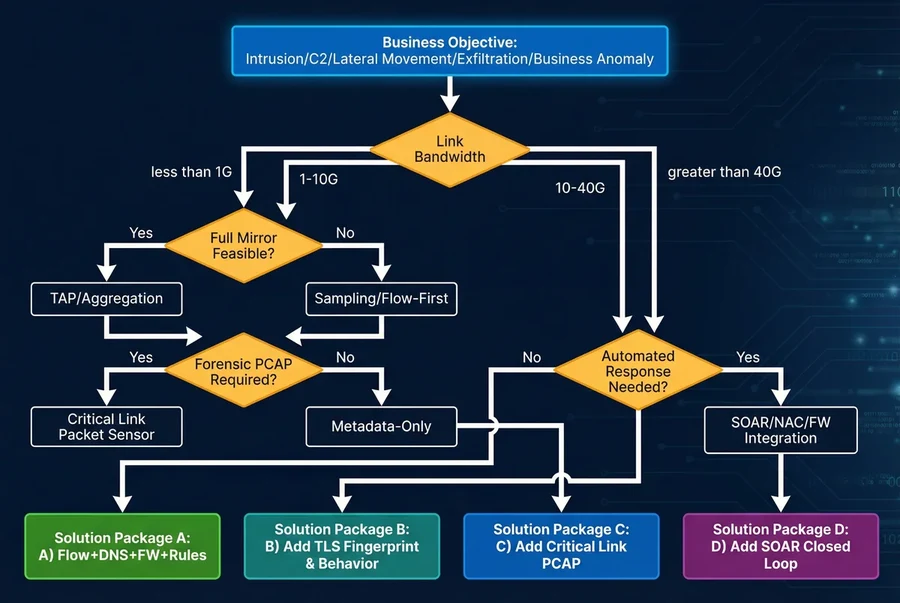
Step-by-Step Decision Method
- Define threat outcomes and prioritized kill-chain stages to detect (C2, lateral movement, exfiltration, business anomaly).
- Build an observation point inventory and rank each point by risk and business value.
- Decide for each observation point: TAP vs. SPAN vs. sampling, and whether PCAP capture is required.
- Choose the telemetry mix: flow, DNS, TLS, HTTP, firewall, proxy, identity — based on detection requirements.
- Size collection, transport, storage, and compute with peak headroom and growth buffer.
- Define the detection catalog with specific use cases and acceptance tests for each detection.
- Integrate operations: case management, response actions, and KPI measurement loop.
| Solution Package | Components | Best Fit | Limitations |
|---|---|---|---|
| Package A: Flow + DNS + FW + Rules | NetFlow/IPFIX, DNS logs, firewall session logs, rule engine, TI matching | Broad coverage, branches, large DC east-west | Limited forensic evidence; no payload visibility |
| Package B: Add TLS Fingerprint & Behavior | Package A + TLS metadata, behavioral analytics, baseline engine | Enterprise egress, exfiltration detection | Requires metadata parsers; privacy considerations |
| Package C: Add Critical Link PCAP | Package B + packet sensors on high-value links, PCAP indexer | DMZ, critical segments requiring forensic evidence | Cost and throughput limits; storage intensive |
| Package D: Add SOAR Closed Loop | Package C + SOAR playbooks, NAC/FW enforcement APIs, automated response | High-maturity SOC with validated playbooks | Operational complexity; requires tuned detections first |
2.4 Key Design Dimensions
NTA/AD system design must be evaluated across multiple dimensions simultaneously. Optimizing for a single dimension — such as detection sophistication — at the expense of others creates systems that fail in production. The following dimensions represent the complete set of considerations that must be balanced in any design decision.
| Dimension | Key Considerations | Design Implications |
|---|---|---|
| Performance & Experience | Ingest latency, query speed, dashboard responsiveness | Hot tier IOPS, index design, query optimization |
| Stability & Reliability | Buffering, redundancy, failover, loss monitoring | N+1 collectors, Kafka replication, dual PSU |
| Maintainability | Modular collectors, schema versioning, upgrade strategy | Blue-green deployments, schema registry, runbooks |
| Compatibility & Extensibility | Multi-vendor flows/logs, API-first integrations | Vendor-agnostic parsers, REST APIs, STIX/TAXII support |
| LCC/TCO | Hardware lifecycle, storage growth, licensing, staffing | Storage tiering, open-source components, automation |
| Energy & Environment | Rack power, cooling, data retention tiering | Power budgeting, cold archive for long retention |
| Compliance | Access control, audit logs, data minimization, encryption | RBAC, immutable logs, TLS transport, data masking |