Network Traffic Analysis and Anomaly Detection Design Guide
A comprehensive engineering reference for designing, deploying, and operating out-of-band network traffic analysis and anomaly detection systems across enterprise, data center, DMZ, OT/IT boundary, and branch environments. Covers observation point strategy, multi-model detection, evidence workflows, and KPI-driven operations.
System Overview
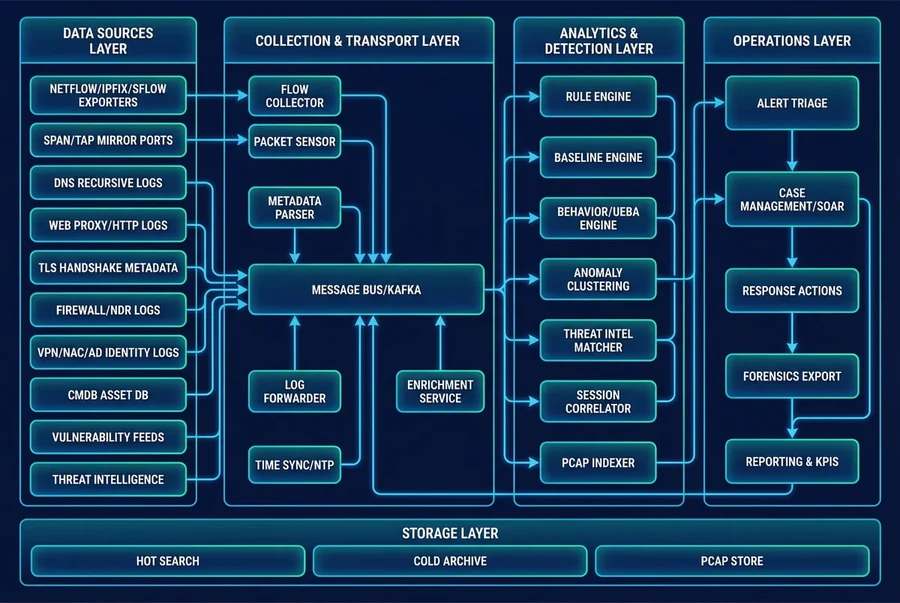
The core of Network Traffic Analysis & Anomaly Detection (NTA/AD) design is to detect intrusions, lateral movement, data exfiltration, and business anomalies using observable data sources combined with strategic observation point deployment, multi-model detection (rules, baselines, and behavioral analytics), and correlation-driven investigation and response closure. This system operates entirely out-of-band — it is non-inline and relies on collecting NetFlow/IPFIX/sFlow records, SPAN/TAP mirrored traffic, DNS/HTTP/TLS metadata, and firewall/NDR logs. All data is then normalized through time synchronization, asset tagging, 5-tuple session keys, and user identity mapping to enable cross-source correlation.
The applicable scope spans enterprise networks, data centers, DMZ segments, OT/IT segmentation zones, branch and WAN environments, and multi-cloud edges. This guide explicitly excludes deep endpoint telemetry replacement (EDR), full DLP content inspection at scale unless explicitly integrated, and inline IPS enforcement on production links unless a separate inline security stack is present. The design philosophy prioritizes visibility breadth before detection sophistication — blind spots invalidate any detection model regardless of its sophistication.
Key inputs to the system include flows, packet metadata, selective PCAP, DNS logs, proxy logs, TLS handshake fingerprints, firewall session logs, asset inventory from CMDB, vulnerability feeds, identity events, and threat intelligence. The system produces prioritized alerts, correlated incident timelines, evidence bundles containing queries, PCAP pointers, and log excerpts, as well as response recommendations and coverage reports that drive continuous detection tuning.
Key System Dependencies
Successful deployment depends on several foundational prerequisites that must be addressed before detection sophistication can be layered on top. Stable SPAN/TAP design ensures that mirrored traffic arrives at sensors without excessive packet loss. Reliable NTP/PTP time synchronization is critical because all correlation logic depends on accurate timestamps across multiple data sources. Accurate CMDB and asset labels enable risk-aware alert prioritization, transforming raw anomalies into actionable intelligence by associating them with business context. Log transport infrastructure using Syslog over TLS ensures telemetry confidentiality and integrity. Storage and compute sizing must account for peak throughput, retention requirements, and query performance. Finally, SOC processes, ticketing integration, and measurable KPIs complete the operational loop.
Main Functions
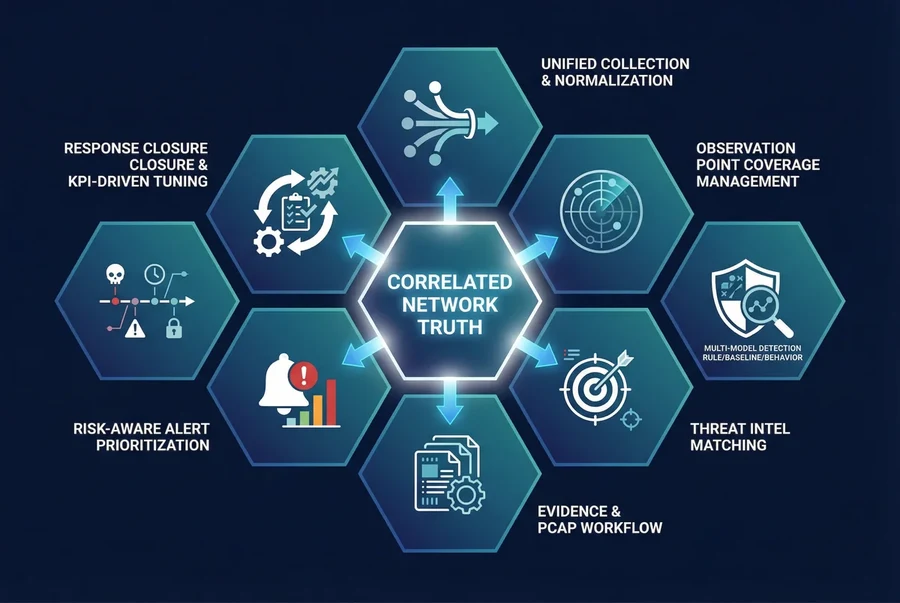
The system delivers seven core functional capabilities that together form a complete network visibility and threat detection platform. Each function has defined acceptance criteria that must be validated during commissioning and tracked continuously during operations.
| Function | Description | Acceptance Focus |
|---|---|---|
| Unified Telemetry Ingestion | Normalize flows, logs, and metadata into a common schema with consistent field naming, timestamp alignment, and source tagging. | Parsing accuracy >99.5%, timestamp fidelity, loss rate <0.5% |
| Coverage & Observation Management | Ensure Internet egress, DMZ, east-west, and management zones are covered; maintain a live coverage map with blind-spot reporting. | Coverage map completeness, blind-spot identification |
| Rule + Intel Detection | Identify known C2 infrastructure, malicious domains, suspicious TLS fingerprints, and IOC matches against threat intelligence feeds. | Match precision, false positive rate <2–5% |
| Statistical Baselines | Detect spikes in bandwidth, connection counts, failure rates, and DNS NXDOMAIN rates using per-asset and per-zone baselines with seasonality handling. | Stable baselines, seasonality handling, drift alerts |
| Behavioral/Clustering Analytics | Detect rare destinations, abnormal ports, low-and-slow exfiltration, scanning, SMB/RDP lateral movement, and DNS tunneling using unsupervised and supervised models. | Explainability, triage usability, analyst-rated accuracy |
| Correlation & Investigation | Merge alerts with asset criticality, vulnerability posture, and identity events to build reproducible evidence chains and incident timelines. | Reproducible evidence chains, time-to-investigate |
| Response Closure Loop | Integrate with ticketing/SOAR, produce response recommendations, track MTTD/MTTR, and drive a structured detection tuning backlog. | Measurable improvement cycle, monthly KPI deltas |
Chapter Navigation
Target Scope & Assumptions
This guide is designed for medium-to-large enterprise organizations and critical infrastructure operators. The typical deployment profile includes one to five Internet egress points, one to three data centers, and ten to one hundred branch sites. The peak aggregate monitored throughput ranges from 2 to 80 Gbps across key observation points, with average utilization at 20–40% of peak. The monitoring focus is network metadata and flow analytics — NetFlow/IPFIX/sFlow, DNS/HTTP/TLS metadata, firewall/NDR logs — plus selective packet capture for incident evidence at critical points.
| Parameter | Specification | Notes |
|---|---|---|
| Traffic Volume | 2–80 Gbps peak aggregate | Average 20–40% of peak |
| Flow Retention (searchable) | 30–180 days | Hot window: 7–30 days on fast storage |
| Cold Archive | Up to 12 months (optional) | Compliance-driven |
| Time Sync | NTP mandatory; PTP optional | Drift p95 <50ms required |
| Identity Mapping | AD/LDAP, VPN, NAC/802.1X, proxy | Best-effort; not all east-west flows have user identity |
| Compliance Baseline | ISO 27001 / SOC2 / local data protection | Configurable data minimization and access logging |
| Deployment Model | On-prem preferred; optional hybrid analytics | No inline latency; mirror/TAP preferred |
| Operations Team | 2–10 security/network engineers | Runbooks, dashboards, and KPIs required |